

What is El Nino?
So dependable is the swing of a pendulum that it has been used for centuries to measure time. The bob moves back and forth on an arc, alternating between stationarity at its highest points and maximum speed at its nadir, with a change from potential energy (due to height) to kinetic energy (due to motion) and back again, in a regular cycle. Oscillations like this are ubiquitous in physical, chemical, biological and geophysical systems.
Amongst the most prominent oscillations of the Earth’s climate is ENSO, the El Niño Southern Oscillation. This occurs, when the temperature of the equatorial Pacific Ocean varies between warm and cold phases, about twice each decade. ENSO is far-reaching in its consequences: weather patterns in Indonesia and Australasia and the monsoons of southern Asia are affected, and East Africa and North America also feel its impact. Droughts and wildfires are common in South-East Asia and Australia, and weather anomalies are global in extent, although less regular or predictable.
Normally, the trade winds blow from the east. During the warm phase of ENSO, known as the El Niño phase, the trade winds weaken or reverse and warm water from the western Pacific flows eastwards. There is a see-saw pattern in which atmospheric pressure in Tahiti is high when it is low in Darwin and vice-versa. ENSO is a two-way interaction between the ocean and atmosphere: sea temperatures are affected by the trade winds and the trade winds are influenced by the sea temperature.
Chicken and Egg
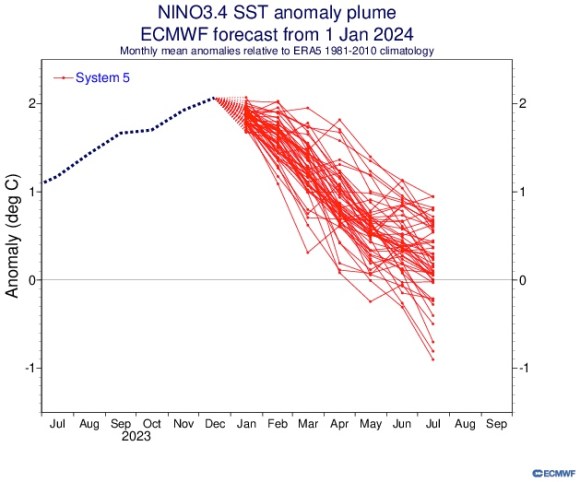
Mechanistic models, involving pendulum equations, are useful for understanding the basic dynamics of ENSO, but they are too simple for prediction of the changes in its phase. For that, more complex and comprehensive coupled atmosphere-ocean models are required. The European Centre for Medium-Range Weather Forecasts (ECMWF) produces seasonal and long-range forecasts on a regular basis. The results are presented as “Niño plume charts”, showing forecasts of sea-surface temperature anomalies the equatorial Pacific Ocean (see diagram).
Currently, ocean temperatures are about two degrees above normal but, over the coming six months, they are expected to return to normal. The diagram shows an ensemble of some fifty forecasts (the red curves), with different background conditions, indicating the end of the current El Niño event, and giving us hope that this year’s weather may be less extreme than 2023.
 ThatsMaths