

To be precise, the time from sunrise to sunset on the equinox is slightly more than twelve hours. One reason is that, due to bending of light by the atmosphere, we can see the Sun while it is still below the horizon, making sunrise earlier and sunset later than simple geometry might suggest. Another reason is the size of the solar disk, which is not just a point source of light. The Spring date on which day and night are of equal length is a few days before the equinox and is known as the vernal equilux.
The Sun follows a path called the ecliptic, which crosses the plane of the celestial equator twice each year, around 20 March and 23 September. The ecliptic is the apparent orbit of the Sun through the zodiac over a year and the celestial equator is an extension of the Earth’s equator into space.
The vernal equinox is often taken to mark the beginning of Spring and the rebirth of nature. This is especially striking in higher latitudes: at the North Pole today, the sun rises for the first time in six months and, for the next few days it will skim westward along the horizon, making a complete circuit every day. For six months it will never set in the Arctic region.
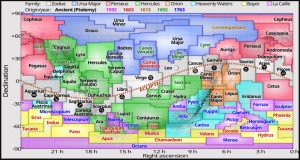
Precession of the Equinoxes
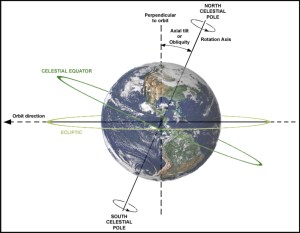
Newton showed how the Earth’s oblate shape was due to its rotation, and he explained that the gradual change in the time of the equinoxes is due to the gravitational pull of the Moon and Sun on the equatorial bulge, causing the planet to precess like a giant spinning top as its axis of rotation slowly traces out a circle in the sky.
We are fortunate to have a large Moon, which has a stabilizing effect on the Earth’s axis. Simulations of the solar system show that, in the absence of the Moon, the Earth’s tilt would vary in an irregular manner, and the precise times of the equinox would be unpredictable. More importantly, the seasonal cycle would become chaotic, with disastrous global consequences.
Due to tidal effects, the Moon is moving slowly away from Earth, although its departure is so gradual that no such catastrophe is expected soon. Ultimately, we may expect chaotic swings in climate, but not for about three or four billion years. However, don’t worry: the increasing luminosity of the Sun will vaporize the oceans long before that.
 ThatsMaths