
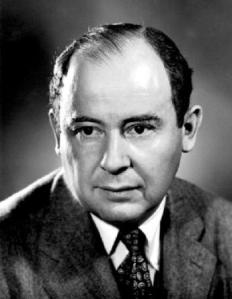
With unique and outstanding achievements in mathematics and science, John von Neumann was on an intellectual level far above us; the oft-misused term genius truly applies to him. Von Neumann, brilliant in both pure and applied mathematics, was a towering figure of 20th century science. As a child, he demonstrated a prodigious memory and computational capacity. He absorbed the numerous volumes of Wilhelm Oncken’s General History, which had coverage from antiquity to modern times and, many years later, was able to quote long sections from it verbatim [TM273 or search for “thatsmaths” at irishtimes.com].
Von Neumann’s father Max feared that mathematics would not provide the security that he wished for his son and persuaded him to study chemical engineering. Thus, von Neumann simultaneously studied engineering at ETH in Zurich and mathematics in Budapest, earning doctoral qualifications in both subjects. His knowledge of chemistry was invaluable for his later work in the Manhattan Project.
The scientific achievements of von Neumann are assembled in six large volumes of his Collected Works. His earliest papers, when he was aged about twenty, were on the foundations of mathematics. The subject was in upheaval at that time, and von Neumann formulated a system of axioms, establishing firm foundations and circumventing a major problem in set theory, Russell’s paradox.
Pure and Applied Mathematician
Following several further advances in pure mathematics, von Neumann established a solid mathematical basis for theoretical physics when, in 1932, he published his book Mathematical Foundations of Quantum Mechanics. This hugely influential work was a standard reference for many decades. Von Neumann continued to develop the mathematical theory underlying quantum mechanics. The third volume of his collected works consists entirely of papers on rings of operators, greatly developing the spectral theory of David Hilbert. He published seven long papers — a total of more than five hundred pages — containing his deepest work as a pure mathematician.
Moving from troubled Europe to the US in 1933, von Neumann took up a professorship at the newly established Institute for Advanced Study (IAS) in Princeton. According to Einstein, another recent arrival at IAS, von Neumann was “one of the most agile minds that ever graced Princeton”.
The Manhattan Project
During and after World War II, von Neumann played a seminal role in the development of atomic and thermonuclear weapons in the Manhattan Project. At Los Alamos he witnessed the extensive numerical calculations carried out by teams of human computers. He realised that electronic computers could do such calculations more accurately and faster than humans.
The ENIAC (Electronic Numerical Integrator and Computer) was one of the earliest automatic computers. Von Neumann saw that it could be used to predict weather and to model climate. With a team of meteorologists led by Jule Charney, he made the first computer weather forecast in 1950. The calculations for a one-day forecast took one day. Five decades later, computing power had grown so rapidly that a simple cell phone was many orders of magnitude more powerful than ENIAC and could run a similar forecast in less than one second.
Von Neumann is regarded today as the grandfather of modern computer design. In 1945, he produced a report setting out the fundamental structure of computers — the von Neumann architecture. Nearly all modern computers, whether mainframes, laptops or cell phones, are built following this pattern. Von Neumann was visionary about the future possibilities for computing and the emergence of artificial intelligence. He foresaw how AI would have the power to propel us to greater levels or to destroy us.
Evening Course, UCD
A UCD course on recreational mathematics, “AweSums: the Majesty and Magnificence of Mathematics”, will be presented this autumn by Peter Lynch — registration is now open. For details, see LINK.
 ThatsMaths