

Astronomical Origins
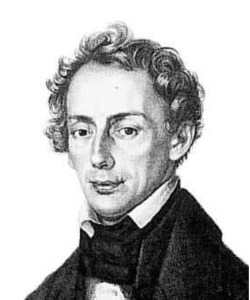
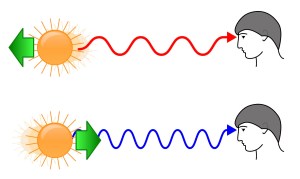
In a binary system, two stars spin around each other. If the plane of rotation is edge-on, an observer sees one star approaching while the other recedes. Supposing both stars emit similar light. Then light from the approaching star is shifted towards the blue end of the spectrum, and light from the receding one has a red shift. After a half-revolution the stars change places, and the colour changes are switched. Austrian mathematician Christian Doppler explained this in an 1842 publication, On the coloured light of the binary stars.
A few years later, the Dutch meteorologist impressively named Christophorus Henricus Diedericus Buys Ballot confirmed the same effect for sound waves. Buys Ballot is better known for his law relating atmospheric pressure and wind direction, one formulation of which is “Stand with your back to the wind; if low pressure is to your left, you are in the Northern Hemisphere.”
Many Applications
There are numerous practical applications of the Doppler effect. Doppler radar, of great value in both civilian and military aviation, can determine the radial speed of moving targets. Speed cameras and laser guns can, from a fixed position, catch drivers violating the speed limit. With Puma equipment, moving Garda cars can detect speeding drivers. Sonar devices are radars using sound waves instead of radio waves. A sonar current profiler measures the speed of currents in rivers and the ocean by detecting the Doppler effect on sound waves scattered from particles in the water. SODAR, which measures wind speeds, works on similar physical principles.
Vascular Doppler ultrasonography helps determine anomalies in the circulatory system. I recently had my carotid arteries checked out by an ultrasound scan, which allows for assessment of carotid arterial blood flow. Flow speed increases in areas of vascular narrowing or blockage within an artery. The sonograph display visualises it in red or blue to distinguish the rate and direction of flow.
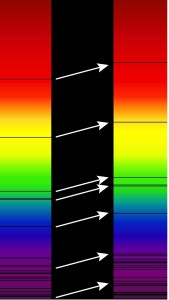
Satellites travel at high speed, with rapidly changing direction, and the effect of Doppler shifting can be large. This has to be compensated by continuously changing the transmission frequency. Another application of Doppler is in weather radar, where clouds and frontal systems are displayed in different colours to indicate their movements. This is invaluable for short-range weather forecasting or nowcasting.
A simple mathematical expression, the Doppler equation, gives the change of frequency in terms of the motion of source and receiver. If the relative speed exceeds the speed of sound, a shock wave is produced, causing a sonic boom. In his classic text, The Theory of Sound, the English physicist, Lord Rayleigh, gave an amusing application of the Doppler equation. A listener moving away from a musical source at twice the speed of sound would hear the piece at the correct tempo and in tune but played backwards.
 ThatsMaths