
The German word Doktorvater for a doctoral advisor indicates the close relationship between a PhD student and his or her supervisor. The relationship is often pivotal in determining the future career of the student, and the advisor also gains much from the interaction. Just as a genealogical tree can reveal fascinating information, a mathematical family tree can illuminate the evolution of the discipline and the roles of the key contributors to its development [TM265 or search for “thatsmaths” at irishtimes.com].
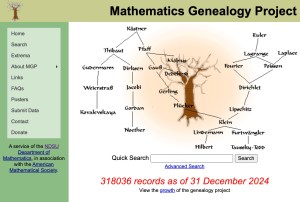
Mathematics Genealogy Project
The Mathematics Genealogy Project (MGP) was initiated in 1996 by mathematician Harry B. Coonce. He was motivated by the difficulty he experienced when trying to find his own “mathematical grandfather”, that is, his advisor’s advisor. The aim of the project is to compile information about all the mathematicians of the world and to trace the intellectual history of mathematics.
The MGP website aims to provide details of all individuals with a doctorate in mathematics, giving the dissertation title and advisor for each. Earlier entries, before PhD programmes were formalised, indicate a mentor/student relationship. The project has grown steadily over the past thirty years and now has more than 300,000 entries. It is managed by North Dakota State University, supported by the American Mathematical Society and by the Clay Mathematics Institute.
MGP is an invaluable aid for mathematical historians, giving a picture of who people are and where they fit in the mathematical spectrum. It has a very inclusive philosophy, welcoming submissions in pure and applied mathematics, statistics, theoretical physics, geophysics, biology, astronomy and computer science. The database has become a standard reference tool. For each recipient of a mathematics PhD, the name of the university or institution, the year the degree was awarded, the thesis title and the name of the thesis advisor are found. This is valuable information for potential employers or collaborators.
The database is also attractive for individuals seeking evidence of an illustrious lineage and is used by mathematicians keen to brag about their esteemed ancestors. It is irresistible to click back through the student/advisor links hoping to find that one is connected to Newton or Leibniz or another of the great mathematicians.
I recently tried this exercise. My own doctoral advisor was Ray Bates, and his was Jule Charney, one of the outstanding meteorologists of the twentieth century. Further back came Poincaré and Helmholtz, both academic giants, but there was no sign of Newton or Euler or Gauss. Persisting, I was led back one thousand years to one Ghiyath al Din Abu al Fath Umar ibn Ibraham al Khayyam al Nisaburi.
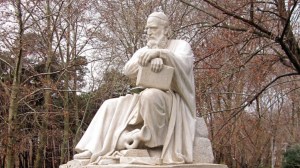
Who could this be? The light dawned: my thirty-sixth Doktorgroßvater was the Persian poet, Omar Khayyam (c. 1048–1131), famed in the West as the author of the Rubaiyat, thanks to Edward Fitzgerald’s 1859 popular translation of the poem. But Khayyam’s mathematical achievements were much more substantial: a renowned scientist and astronomer, he was an outstanding mathematician, his most famous work being a treatise on Algebra, written in Samarkand around 1075 when he was just 25 years old. This work contained a complete classification of cubic equations, with geometric solutions in terms of intersecting conic sections.
The MGP database lists the number of descendants, that is, the number of students, students of students, and so forth. Lest I appear boastful about a link to Khayyam, I should admit that the database lists for him a total of more than 230,500 descendants.
* * *
The ThatsMaths blog has been placed Number 35 on a list of the Top 90 Best Math Blogs for Students and Mathematics Teachers: See URL .
 ThatsMaths