

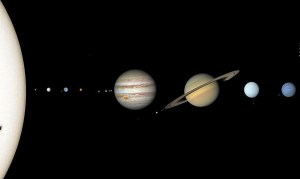
In his classical textbook on mechanics, Edmund Whittaker described the three-body problem as “the most celebrated of all dynamical problems”. From 1906 to 1912, Whittaker was Andrews Professor at Trinity College Dublin and Royal Astronomer of Ireland. The three-body problem is to determine the motion of three massive bodies moving in space under mutual gravitational attraction, for example, the Sun, Earth and Moon. The problem is intimately linked to the question of the stability of the solar system [TM271 or search for “thatsmaths” at irishtimes.com].
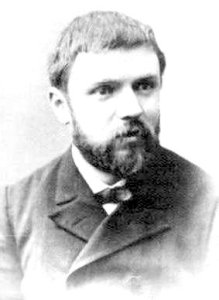
Thousands of technical papers on the three-body problem have appeared and its study has led to substantial advances in mathematics and physics. In 1887 the brilliant young French mathematician Henri Poincaré submitted a memoir on the topic for a prize announced in the Swedish journal Acta Mathematica. The prize, a gold medal and 2500 crowns, was to celebrate the sixtieth birthday of King Oscar II. As a student, Oscar had distinguished himself in mathematics and he later became an active patron of the subject.
The competition was coordinated by Gösta Mittag-Leffler, a Swedish mathematician and editor of Acta Mathematica. The King proposed a judging panel of five leading mathematicians of international renown but, from the outset, the project was beset by difficulties. How could five venerable mathematicians ever agree on the merits of a memoir? Would each one not refuse to serve once he learned the names of the others? Might not each be outraged that the others were chosen along with him? Ultimately, a panel of three members was selected, Karl Weierstrass from Germany, Charles Hermite from France and Mittag-Leffler himself. Mittag-Leffler had studied under Weierstrass and Hermite and knew them both well.
Competition entrants could choose their own topic or select one from a list of four problems proposed by the jury. Twelve entries were received by the closing date in 1887 and the judges quickly identified Poincaré’s memoir as a clear winner. Their choice was approved by the King and the memoir was prepared for publication.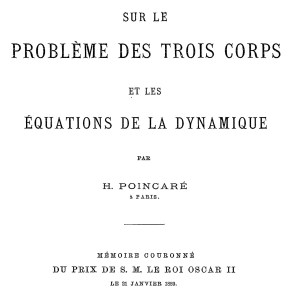
An Error
In the meantime, Poincaré had discovered a serious error in his work. Although the paper had already been printed, publication was postponed. It took Poincaré six months of intensive work to overcome the problem and substantially revise his memoir. News of the difficulties leaked out and Mittag-Leffler took steps to avoid a scandal — the term cover-up springs to mind.
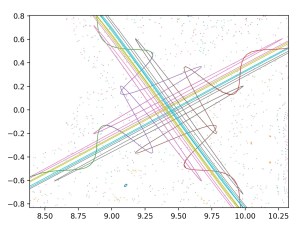
The amended memoir was published more than a year late, and the gold medal was presented to Poincaré, then aged just 35. Stories of the error soon fizzled out as the brilliance of Poincaré’s work was quickly recognized, even if leading mathematical luminaries struggled to understand it in complete detail. Thus, King Oscar’s sixtieth birthday was marked — belatedly — by important new methods of mathematics.
Poincaré’s continuing research on dynamics was crowned by his three-volume opus, Les Méthodes Nouvelle de la Méchanique Céleste. This led on to the emergence of modern dynamical systems theory and, in the 1960s, to the work of Kolmogorov, Arnold and Moser, a dramatically innovative approach to dynamics now called KAM theory. Poincaré was first to clearly elucidate the chaotic behaviour of physical systems and the inherent difficulties of long-range prediction. He died on this day, 113 years ago, aged just 58 years.
 ThatsMaths