Which is greater, or ? Of course, it depends on the values of x and y. We might consider a particular case: Is or ?
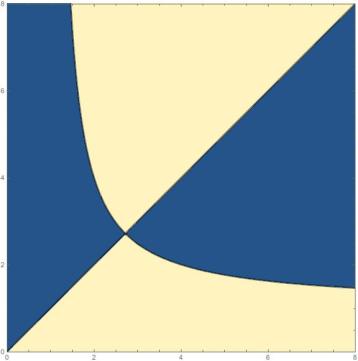
Contour plot of x^y – y^x, positive in the yellow regions, negative in the blue ones.
We assume that and are positive real numbers, and plot the function
In the contour plot, we show the areas of the quadrant , where the function is positive (shaded yellow) and where it is negative (shaded blue). The quadrant is divided into four regions by two curves upon which . The first is the diagonal line , which clearly makes vanish. The second is a curve that passes through the point . This hyperbola-like curve is asymptotic to the lines and .
What is the nature of this curve? Since it corresponds to , we have
Obviously, solves this. But there are other solutions. Drawing the graph of we see that, for any there is another point for which .
The function is related to the Lambert W-function. Analytically-minded readers might like to establish this relationship explicitly.
Is e^pi less than or greater than pi^e?
We return now to the simple question: is or ? We locate the point in the quadrant. If it falls in a yellow region, then . If in a blue region then .
Clearly, is in the yellow region directly above the point . Therefore . A calculator confirms that and .













 ThatsMaths