


Max Margules (1856–1920)
Max Margules studied mathematics and physics at Vienna University and among his teachers was the renowned physicist Ludwig Boltzmann. In 1904, Margules contributed a short paper for the Festschrift to mark Boltzmann’s sixtieth birthday.
Margules considered the possibility of predicting pressure changes by means of the continuity equation. He showed that, to obtain an accurate estimate of the pressure tendency (
Said Margules, with trepidation,
“There’s hazards with mass conservation:
Gross errors you’ll see
In dee-pee-dee-tee,
Arising from blind computation.”
The Tendency Equation
An equation for the pressure tendency can be derived from the hydrostatic equation and continuity equation. The integrated form of the hydrostatic equation is

This is a mathematical statement of the physical assumption that the pressure at any point is determined by the weight of air above it.
The physical principle of mass conservation is expressed mathematically in terms of the continuity equation, a partial differential equation:

where 


where 

This was discovered, to his cost, by Richardson with the result that he obtained an unreasonable value for the pressure change.
The Problem in Detail
It is possible to give a quantitative description of the essential physical processes that cause changes in surface pressure without recourse to complicated mathematics. All that is required is a knowledge of how powers of ten are manipulated. We first recall that the pressure at a point is determined by the mass of air above it. This is the hydrostatic approximation, and is found to hold to a high degree of accuracy for the atmosphere.
The density of air decreases with height because of compressibility, and the atmosphere extends indefinitely in the vertical direction. However, in some ways its behaviour resembles that of an incompressible fluid layer of finite depth.
The mean surface pressure is about 1000 mbar or 100,000 Pascals (
We take the density to be numerically equal to one (comparable to air) and the gravitational acceleration as 


For simplicity, we substitute for the compressible atmosphere a layer of incompressible fluid of mean depth ten kilometres. The total mass of the atmosphere is constant. Let us consider a geographical region bound by the four sides of a square of side 10 kilometres. As an example, think of Central London from Notting Hill to Wapping and Holloway to Clapham (Figure, panel a). The area of the region is the square of the side, or 
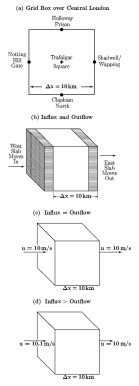 The column of fluid above this square forms a cube whose volume is the area multiplied by the depth, or

Convergence and Divergence
How does the pressure at a point change? Since pressure is due to the mass of fluid above the point in question, the only way it can change is through fluxes of air into or out of the column above the point. Nett inward and outward fluxes are respectively called convergence and divergence.
Let us suppose that the movement of air is from west to east, so that no air flows through the north or south faces of our cubic column. Let us further assume for now that the wind speed has a uniform value of ten metres per second. Thus, in a single second, a slab of air of lateral extend 10 kilometres, of height ten kilometres and of thickness ten metres, moves into the cube through its western face (Figure, panel b).
This slab has total volume of 
However, there is a corresponding flux of air outward through the eastern face of the cube, with precisely the same value (Figure, panel c). So, the nett flux is zero, the total mass of air in the cube remains unchanged, and the pressure at the surface remains constant.
Now suppose that the flow speed inward through the western face of the cube is slightly greater, let us say 1% greater at 10.1 metres per second, while the speed outward through the eastern face remains at 10 metres per second (Figure, panel d). There is thus more fluid flowing into the cube than out of it: there is a nett convergence of mass into the cube. We may expect a pressure rise; let us now calculate it.
The additional inward flux of mass is 1% of the total inward flux, or 


Little Things Mean a Lot
A pressure tendency of 1 Pa/s may not sound impressive, but we shall soon see that, if the relatively small difference between inflow and outflow is sustained over a long period of time, the resulting pressure rise is dramatic. We recall that there are 86,400 seconds in a day. To confine the arithmetic to powers of ten, let us redefine a day to be a period of 100,000 seconds (about 27 hours 46 minutes).
So, our day is 
An even more paradoxical conclusion is reached if we consider the speed at the western face to be 1% less than, rather than greater than, the outflow speed at the eastern face. The above reasoning would suggest a decrease of pressure by 100% in a day, resulting in a total vacuum and leaving the citizens of London quite breathless.
Of course, there is a blunder in the reasoning: as the mass in the cube decreases, its volume must decrease in proportion, since the density is constant. In effect, the fluid depth, which we have taken to be constant, must decrease.
Conclusion
We have re-examined the numerical weather forecast made by Lewis Fry Richardson in the light of Margules’ findings. Richardson employed the method that Margules had shown to be problematical; as a result, his prediction was completely unrealistic. It appears that Richardson was unaware of Margules’ paper, although a copy was received by the U.K. Met Office Library in 1905.
The predicted pressure change calculated by Richardson was utterly unrealistic but his methodology was sound and, indeed, underlies modern computer weather forecasting. Historically, primitive equation models used data that was modified, in a process called initialization, to remove spuriously large gravity-wave components, thereby avoiding unrealistic pressure changes.
Sources

 ThatsMaths