
 I attended the sixth conference of the Irish History of Mathematics (IHoM) group at Maynooth University yesterday (Wednesday 30th August 2023). What follows is a personal summary of the presentations. This summary has no official status. If speakers or attendees spot any errors, please let me know and I will correct them.
[1] After a brief introduction by Dr Ciarán Mac an Bhaird of Maynooth University, the presentations began with a talk by Dr Padraig Ó Catháin of Dublin City University, who spoke about a famous inequality due to Jacques Hadamard (1893), which establishes a bound for the determinant of a matrix in terms of an upper bound on the matrix entries. He traced the historical development of this result and its generalisations, showing how the original proof was cumbersome but, over time, the proofs became simpler and more elegant.
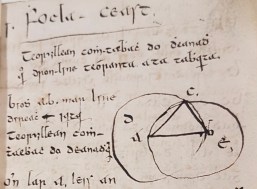
[3] The next talk, presented by Dr Olivia Lardner of the University of Limerick, was on the Bolton Library in Limerick University, assembled over a 75-year period between 1669 and 1744 by two Irish scholars, both of whom went on to become Church of Ireland archbishops: William King in Dublin and Theophilus Bolton in Cashel. The library includes several important works on mathematics. A wealth of information exists on the activities of King, but little is known about Bolton. In the talk, Dr Lardner considered three mathematical volumes, two manuscripts and one early printed book, acquired by Archbishop King.
[4] The next talk, On Newton’s series for sine and arcsine, was given by Prof Piotr Blaszczyk of the Pedagogical University of Kraków, who examined Newton’s Two Treatises of the Quadrature of Curves and Analysis by Equations of an Infinite Number of Terms from the perspective of mathematical techniques. In this work, Newton derived series for the sine and arcsine functions. The focus was on the technique of formal power series, which enabled Newton to determine the derivatives and integrals of the inverse functions.
Berkeley’s Pamphlet
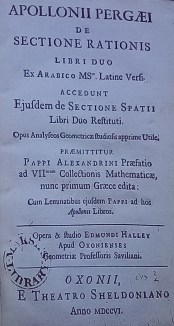
[5] In a talk entitled Who was J. Walton, Berkeley’s Dublin antagonist? Prof Rod Gow of UCD discussed the famous pamphlet “The Analyst: or a Discourse addressed to an Infidel Mathematician”. This was published in Dublin and London in 1734. Although anonymous, there is no doubt about the author, George Berkeley, then Bishop of Cloyne. The pamphlet, the target of which may have been Edmond Halley, was severely critical of Newton’s method of fluxions, and led to several responses from supporters of Newton, with some (anonymous) replies from Berkeley. The talk focussed on two pamphlets written by one J. Walton, A vindication of Sir Isaac Newton’s principles of fluxions, and The catechism of the author of the minute philosopher fully answer’d. It seems that Walton was a wealthy man with scientific interests and contacts to prominent Dubliners, and Prof Gow revealed further information arising from his sleuth-work. There are letters from J(acob) Walton concerning auroras in the archive of the Royal Society.
[6] A presentation on the theory of proportionality in Ancient Greek Geometry, by Dr David Wilkins of Trinity College Dublin, followed. He explored the potential for geometric approaches to proportionality prior to Eudoxus’ theory of proportionality. Dr Wilkins showed that the majority of the propositions in Book 6 of Euclid’s Elements of Geometry could be proved on the basis of the concepts, propositions and proof techniques in the first four books of the Elements, independently of the contents of Book 5, in which the theory of proportionality attributed to Eudoxus is presented. He mentioned the “foundational crisis” in mathematics arising from the discovery of irrationals which — if it really occurred — was resolved by the work of Eudoxus.
Apollonius
[8] Dr Mark McCartney, of the University of Ulster, followed with a talk having the intriguing title “The Lion, the Witch & the Maths Graduate: studying maths at Queen’s College, Belfast in the 1880s”. That decade witnessed the dissolution of the Queen’s University of Ireland, the formation of the Royal University of Ireland, and the admission of women as students to Queen’s College Belfast. The talk considered the mathematics curriculum and examinations around that time and also something of the life and mathematical achievements of Flora Augusta Hamilton. The origin of Mark’s title became clear when he revealed that Flora was the mother of C.S.Lewis.
[9] The final presentation, by Dr Maurice O’Reilly, Dublin City University, asked “What’s happening in the History of Mathematics Education? Perspectives from ICHME7”. He reviewed the proceedings of the seventh International Conference on the History of Mathematics Education (ICHME7) in September 2022 in Mainz, Germany, where 32 papers were presented. He reviewed a representative selection of the presentations under six headings. One category was the reception of the New Math from the 1960s. Publication of the Proceedings of ICHME7 is imminent (see ICHME7 site).
[-X-] A presentation was Prof Harald Gropp from the University of Heidelberg, on the dates of Easter Sunday in the early Irish church calendar, had to be omitted as Prof Gropp was unable to attend the meeting. His abstract informed us that, in 2019, we all celebrated Easter Sunday on the wrong Sunday, 24 March instead of 21 April. As the talk was cancelled, the explanation for this surprising claim remains a mystery (at least, to me).
Sources
I acknowledge the collection of Abstracts on the IHoM6 conference website. PowerPoint/PDF files of a selection of the presentations will appear on that site in due course. The IHoM6 website address is: https://www.maynoothuniversity.ie/mathematics-and-statistics/IHoMC6
 ThatsMaths