
In blue sky research, real-world applications are not the immediate goal. Purely curiosity-driven science can challenge accepted theories and lead to entirely new fields of study. The mathematical techniques devised by Sligo-born scientist George Gabriel Stokes to elucidate the physics of rainbows are crucial in fibre-optic communication, so vital today in our technical world. Stokes’ work provides tools essential for solving many problems arising in modern applied mathematics and physics [TM281 or search for “thatsmaths” at irishtimes.com].
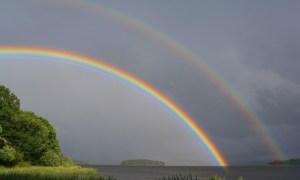
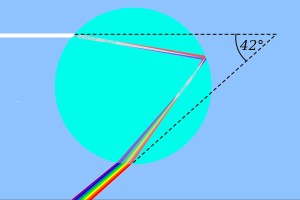
Since the colours are refracted by different angles upon entering a water droplet, with red bending least and blue most, a beam of white light splits into its constituent colours. The primary bow is due to two refractions and one reflection of sunlight within a myriad of water droplets (see illustration). The primary bow is at an angle of 42 degrees from its centre. The colours vary across the bow, with red on the outside and violet on the inside. Frequently, a secondary bow can be seen outside the primary one, at an angular distance of 51 degrees, with a dark band between the two bows. In the second bow, the light bounces twice, and the colours are reversed, with red inside and blue outside.
Supernumerary Bows
Various fine details of rainbows have challenged mathematicians and physicists over the past few centuries. The sky within the primary bow is noticeably brighter than outside. When the Sun is low, the sides of the bow are almost vertical and appear brighter due to greater droplet sizes low down. The droplets are smallest near the top of the bow and different light rays can weaken or reinforce each other. This light interference produces supernumerary bows, seen as a series of pink and green arcs just below the crest of the bow. The spacing of these bands varies with droplet size. Their explication required some advanced mathematical analysis.
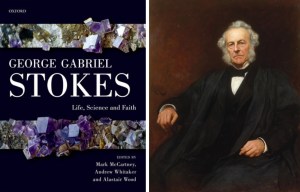
George Biddell Airy obtained an integral (a mathematical expression) for the brightness of each colour across the width of the bow. However, he encountered difficulties in evaluating the integral. George Gabriel Stokes developed what is called an asymptotic expansion for the integral to clarify the properties of supernumerary bows. Stokes’ mathematics contains the essential elements of the modern saddle point and stationary phase methods, which are invaluable in solving a broad category of differential equations, and are of lasting value to mathematicians and physicists.
References
- Richard Paris, 2019: Stokes’s Mathematical work. Chapter 7 in George Gabriel Stokes: Life, Science and Faith. Mark McCartney, Andrew Whitaker, and Alastair Wood, (Editors). Oxford Univ. Press. 264 pages, ISBN: 978-0-1988-2286-8
- Anne B. O’Donnell, 1996: The Work of G.G. Stokes in Evaluating the Airy Rainbow Integral and its Ramifications Today. Master of Science Thesis, Dublin City University, 1996. URL: https://www.academia.edu/118549388/The_work_of_G_G_Stokes_in_evaluating_the_Airy_rainbow_integral_and_its_ramifications_today

