

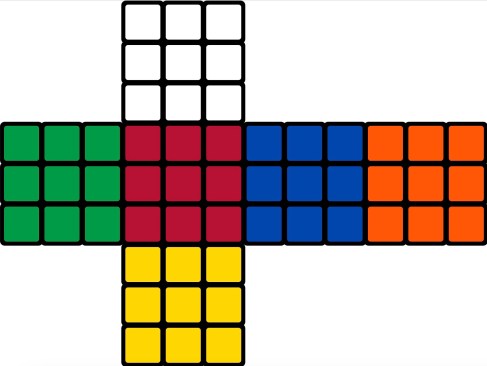
On the classic Rubik’s Cube, the six faces are covered by nine stickers, each face being a different colour: white, red, blue, orange, green, and yellow. The colours are arranged in a conventional pattern. The cube is made up of smaller cubes, interlocked in an ingenious manner that enables them to rotate in groups around the centre, allowing a truly enormous number of possible configurations. A move consists of twisting the nine cublets of any face through 90 or 180 degrees. But how many twists are needed to unscramble an arbitrary position?
The Rubik Group
 The cube has eight corners and twelve edges. Each corner has three possible orientations and there are 8! ways to arrange the corner cubes. There are 12! / 2 ways to arrange the edges. In total, the number of distinct configurations is 43,252,003,274,489,856,000 (according to Wikipedia), which is approximately 43 followed by 18 zeros. Clearly, a brute-force search for solutions to every possible scrambled position is impractical.
Several systematic strategies, or solution algorithms, have been devised. These are fool-proof and robust, but generally far from optimal, requiring typically between 50 and 100 moves. In addition to these, enthusiasts have an arsenal of techniques that enable them to solve the cube in a matter of seconds.
Group Theory and Symmetry
Group theory is the branch of mathematics dealing with symmetry. The Rubik’s cube is replete with symmetries. Even before twisting any faces, we can orient the cube in 24 ways: there are six choices for the top face and, given this, four for the front. Symmetries such as these allow us to reduce drastically the search space, or cube group, when seeking a solution. Rubik’s Cube can be solved by application of group theory. For example, if X and Y are simple moves, the pattern XYX↑-1Y↑-1 often occurs (this means: do X, then Y then the reverse of X, then the reverse of Y). This is known as a commutator structure. The pattern XYX↑-1, known as a conjugate structure, is also common. Solution methods are made up from combinations of such patterns.
Videos on You-tube explain a wide range of approaches to solving the cube. They can be mastered, incrementally, by progressing through several levels of difficulty. The Wikipedia article on Rubik’s cube also gives a good account of elementary solution techniques, and of the specialised notation used to describe them. A number of solutions are known that allow the cube to be solved in under 100 moves.
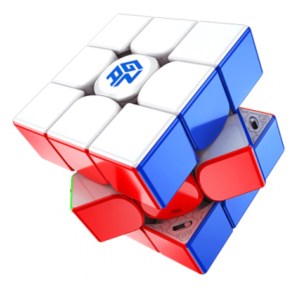
The CFOP method is one of the most commonly used solution algorithms, and is possibly the fastest method. The method works by first solving a cross, typically on the bottom, continuing to solve the first two layers together, orienting the last layer, and finally permuting the last layer. The method requires a large number of patterns to be learned.
Any starting position of Rubik’s cube can be solved in at most 20 moves. However, while a powerful computer can find such a solution, no practical method is known that can be used by a human to solve the cube in 20 turns. The best general algorithms require at least twice as many moves as this, and cube-lovers continue the quest for faster solution methods.
Interest in Rubik’s cube continues, with a focus on speed-cubing. The World Cubing Association sanctions hundreds of tournaments each year. Better cubes, faster algorithms and more finger-tricks have brought the world record down to just a few seconds. The world record time for solving a single cube is 3.13 seconds, held by Max Park of the United States, achieved in June 2023. The world record for the average of five solves is 4.48 seconds, set by Yiheng Wang of China, also in June 2023. And a robot has been built that solves the puzzle in under 5 seconds.
Sources

 ThatsMaths