
The Tower of Jesus Christ, part of the Basilica de la Sagrada Família, was inaugurated last week. The basilica is the magnum opus of visionary architect Antoni Gaudí, considered the great master of Catalan Modernism. Gaudí’s unique architecture is evident throughout Barcelona but his crowning glory is the Sagrada Família [TM282 or search for “thatsmaths” at irishtimes.com].
Gaudí began his studies in 1852 when aged sixteen. He enjoyed geometry and wanted to use his knowledge of curves, surfaces and solids in a practical way. His mathematical studies deeply influenced his creation of unique architectural forms. While his grades were indifferent and he occasionally failed courses, Gaudí clearly stood apart, leading the School Director awarding his degree to remark “We have given this academic title either to a fool or a genius. Time will tell”. Any justification for such ambivalence has long since vanished.
Many of the curves and surfaces found in Gaudí’s architecture reflect his study of forms found in nature. Arguing that straight lines and sharp angles are rare in the natural world, Gaudí felt they should not dominate buildings. His arches include parabolas and catenaries. A parabola is the curve followed by an object lobbed through the air, while a catenary traces the form of a hanging chain. The two curves are similar but the catenary is flatter near the vertex and steeper further away. It has the critical property that the nett force acting on it is tangential to the curve, so that it is self-supporting, as every student of architecture learns.
Ruled Surfaces
If you hold a pencil vertically and rotate it around a horizontal circle, it will sweep out a cylinder. In a similar way, more exotic surfaces can be generated from straight lines. Gaudí used several such ruled surfaces in his designs, the most notable being the hyperboloid of one sheet and the hyperbolic paraboloid. We see the former in huge cooling towers and the latter in saddles and pringle crisps.
Architects are fond of ruled surfaces, which can be constructed from straight rods and beams. Some spectacular staircases in the basilica take the form of ruled surfaces called helicoids. To visualise one, rotate a pencil in a horizontal plane about its tip while simultaneously raising the plane vertically; the pencil will sweep out a helicoid.
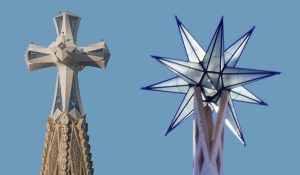
Structures in the form of spheres, ellipsoids and paraboloids can also be found in the basilica. Gaudí kept models of the five Platonic solids in his workshop. Topping the Tower of Mary is an extraordinary form called a stellated dodecahedron, formed by placing pentagonal pyramids on the twelve faces of a dodecahedron.
Nearer to Heaven
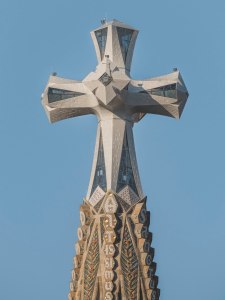
The basilica became the world’s tallest church when the huge 3-dimensional cross topping the Tower of Jesus Christ was installed in February, raising the height to more than 170 metres. The cross is an octa-cube, comprising 8 cubes in a 3-dimensional form (see illustration). It is also a projection of a 4-dimensional hypercube. For more information about the construction of the cross, see https://blog.sagradafamilia.org/. The blessing and inauguration of the tower by Pope Leo XIV marked the 100th anniversary of Gaudí’s death. His vision is nearing its full realisation: completion of the basilica, on which work began in 1882, is expected within ten years.
If you are heading for Barcelona, bring your old geometry book or — better yet — a copy of The Genius of Gaudi by Claudi Alsina and Roger Nelsen. This book explores the mathematical elegance underlying Gaudí’s extraordinary creations and includes hundreds of photographs, illustrating his use of geometry, with particular focus on his masterpiece, the Basilica de la Sagrada Família.

