

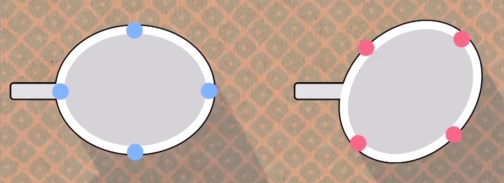
When tapped at any of the four cardinal points (North, South, East or West), a teacup with its handle towards the North emits the same ringing sound; when the tap is displaced by 45°, the note is about a semitone higher. The tapping distorts the circular rim, which is rapidly stretched and squeezed in perpendicular directions, like a pulsating ellipse. The difference in pitch is due to the inertia of the handle: with taps at the cardinal points, the handle oscillates back and forth; with taps at the secondary points, the handle remains unmoving at a node or static point, so the oscillations are more rapid and higher in pitch [TM283 or search for “thatsmaths” at irishtimes.com].
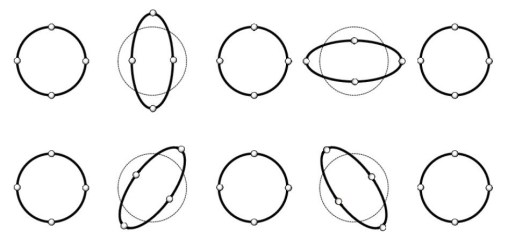
From Einstein’s general relativity theory, several new phenomena became apparent. Black holes were anticipated by early solutions of his equations. Einstein also showed that, just as matter can bend space, accelerating matter can cause spacetime to oscillate, generating ripples that spread out at light speed. Einstein believed that they would be too weak to be observed. Indeed, a century elapsed before these gravitational waves were detected.
LIGO
When two massive black holes collide, they trigger what might be called a space-quake, radiating waves that travel at light speed through the cosmos. LIGO (a land-based gravitational wave observatory) comprises two interferometer arrays, one in Louisiana and one in Washington State, which can detect the distortions of spacetime resulting from gravitational waves. LIGO has two laser beams and two detectors 3000 kilometres apart. In September 2015 both arrays observed gravitational waves from the merger, over a billion years ago, of two black holes.
The scope of the earth-bound LIGO observatory is limited by its physical size. To detect a broader range of gravitational waves, a much larger array is required. The Laser Interferometer Space Antenna (LISA) mission is led by the European Space Agency (ESA) with NASA as a major partner. This space-based array will be able to detect gravitational waves in a lower frequency band than LIGO. LISA is scheduled to launch in 2035.

The LISA mission comprises a constellation of three spacecraft, arranged in an equilateral triangle with sides of 2.5 million kilometres, following the orbit of Earth around the Sun. Each spacecraft carries two telescopes and two lasers pointing at the other two spacecraft. When gravitational waves pass the array, the lengths of the arms vary due to spacetime distortions caused by the waves. LISA is sensitive to the low-frequency band of the gravitational-wave spectrum and will be able to detect mergers of compact stellar objects — white dwarfs, neutron stars and black holes — in the Milky Way.
The history of astronomy has shown us that, following each new method of observation, unanticipated phenomena are discovered. LIGO and LISA represent a symbiotic blend of mathematics, physics, computer science and engineering. Science and technology in synergy have initiated an entirely novel field — gravitational wave astronomy — opening a new window on the universe.

