

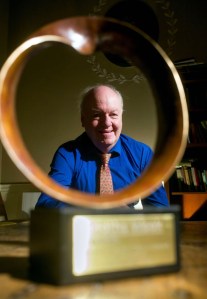
Attending the inaugural meeting of the Irish Mathematical Society at Trinity College Dublin in 1976, I never dreamt that I would be present at the Annual Meeting last month when the society, now with more than 300 members, celebrated its golden jubilee, also held in Trinity College. The IMS was established to promote mathematics and mathematical research in Ireland, by arranging and supporting conferences, awarding students and publishing a bulletin twice each year. The majority of society members work at Irish universities and other third-level institutes [TM285 or search for “thatsmaths” at irishtimes.com].
Among the highlights of the jubilee meeting was a lecture by Colm Mulcahy, Professor Emeritus at Spelman College, Atlanta, Georgia. Colm studied mathematics at UCD and then at Cornell University, where he achieved his PhD in algebra. He is well known in mathematics outreach circles, and is an active and enthusiastic supporter of Maths Week in Ireland. Colm is also internationally recognised as an expert in mathematical card tricks, and he has published a book on this topic.
 The establishment of the Annals of Irish Mathematics and Mathematicians (AIMM) was initiated by Colm in December 2014, originally aiming to track all Irish students who earned advanced mathematics degrees. The objectives of AIMM are to foster a deeper knowledge and appreciation of Irish mathematics and mathematical sciences, both in academic circles, and among the general public, to assemble information about Irish mathematicians over the past several centuries, and to provide a dynamic electronic archive of Irish mathematics and mathematicians, openly available to current and future researchers.
“What have the Irish ever done for mathematics?” That was the title chosen by Colm for his talk, and the comprehensive answer may come as a surprise. Many of us have heard of William Rowan Hamilton, but numerous others, Irish or with Irish connections, have made major contributions: George Berkeley, George Boole, George Stokes, George FitzGerald and thousands more not called George.
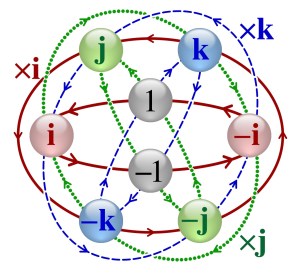
Among Hamilton’s many other accomplishments are his brilliant reformulation of mechanics, in which he represented a dynamical system by a single mathematical function now called the Hamiltonian, and depicted the motion in a multi-dimensional arena called phase space. This formalism proved, many decades later, to be an ideal framework for quantum mechanics, fundamental for physics at atomic scales.
The influence of Irish mathematical science is wide, and Irish scholars have driven research at some of the world’s leading centres in Europe, America and elsewhere. AIMM documents over 5000 mathematical people who are Irish, worked in Ireland, or had Irish doctoral advisors. Colm continues to develop and expand the Annals, which have become a substantial and invaluable resource on Irish mathematics. The database includes several special sections documenting the geographical origins of Irish mathematicians, books by and about Irish mathematicians, and the contributions of women to maths in Ireland. Clicking “blog” at www.mathsireland.ie, you will find close to a hundred posts on numerous aspects of mathematics with an Irish connection.

Click here for more on Colm’s talk to the Irish Mathematical Society’s 50th anniversary conference, including a PDF of his slides.

