
It is said that an inscription — Let no one ignorant of geometry enter here — was carved over the entrance to Plato’s Academy in Athens. Although Plato made no original geometric discoveries, he believed that mathematics provides the finest possible mental training, and regarded it as an essential prerequisite for philosophy. He formalised the concept of proof, laying the foundations for Euclid’s Elements. When he died in 347 BC, Plato was buried in the large garden of the Academy. But where?
The Herculaneum scrolls
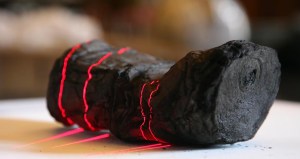
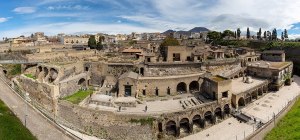
Recently, the precise location of Plato’s tomb has been discovered, not by an archaeological dig, but by analysis of a papyrus reduced to charcoal following the eruption of Vesuvius in AD 79. The volcanic eruption destroyed the cities of Pompeii and Herculaneum, burying them under tens of metres of rock and ash. About eighteen hundred papyri were found around 1750 at an ancient Roman villa now called the Villa of the Papyri. These scrolls were completely carbonised by the intense heat of the eruption, and quite impossible to read.
Attempts to unroll and flatten some of the Herculaneum scrolls reduced them to dust and ashes, destroying any chance of deciphering them. But recently scholars have been able to recover the text on some scrolls by non-invasive scanning techniques. The scrolls have been X-rayed using CT scanners similar to those found in hospitals. 3D images are built up representing the solid spiral scrolls. By clever mathematical transformations, the scans are virtually unrolled to produce flat images of the papyri while leaving the physical scrolls untouched.
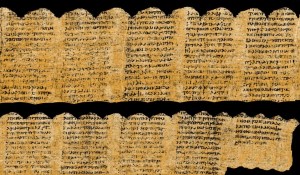
Thousands of words of a document by the Epicurean philosopher Philodemus, The History of the Academy, have been deciphered. They include a description of Plato’s tomb, located close to the Mouseion, a temple dedicated to the muses. This information lay buried for two millennia, only to be rediscovered in 2024.
The papyri contain a large number of Greek philosophical texts, some previously unknown. There is also what is believed to be a lost work about Alexander the Great. We may be confident that non-destructive scanning of fragile, unopened scrolls will provide further breakthroughs in our knowledge of the classical world. New decipherment techniques are under development, and perhaps many more charred scrolls lie undiscovered at deeper, unexcavated levels of the Villa.
The Vesuvius Challenge
The Vesuvius Challenge is an open competition to read the carbonised scrolls. It was launched in 2023 by tech moguls and Meta executives, Nat Friedman and Daniel Gross, and computer science professor Brent Seales, to encourage innovation in deciphering. Numerous cash prizes, some quite large, are on offer for progress in deciphering them. For information about the Vesuvius Challenge, go to https://scrollprize.org/

