
The Voyager 1 and Voyager 2 spacecraft have now left the solar system and will continue into deep space. How did we manage to send them so far? The Voyager spacecraft used gravity assists to visit Jupiter, Saturn, Uranus and Neptune in the late 1970s and 1980s. Gravity assist manoeuvres, known as slingshots, are essential … Continue reading Slingshot Orbit to Asteroid Bennu
More on Moduli
We wrote last week on modular arithmetic, the arithmetic of remainders. Here we will examine a few other aspects of this huge subject. Modular arithmetic was advanced by Gauss in his Disquisitiones Arithmeticae. In this system, number wrap around when they reach a point known as the modulus. Numbers that differ by a multiple of … Continue reading More on Moduli
Modular Arithmetic: from Clock Time to High Tech
You may never have heard of modular arithmetic, but you use it every day without the slightest difficulty. In this system, numbers wrap around when they reach a certain size called the modulus; it is the arithmetic of remainders [TM126 or search for “thatsmaths” at irishtimes.com]. When reckoning hours, we count up to twelve and start again … Continue reading Modular Arithmetic: from Clock Time to High Tech
Malfatti’s Circles
Sometimes the “obvious” answer to a mathematical problem is not the correct one. The case of Malfatti's circles is an example of this. In an equilateral triangle of unit side length, we must draw three non-overlapping circles such that the total area of the circles is maximal. The solution seems obvious: draw three identical circles, … Continue reading Malfatti’s Circles
Learning Maths has never been Easier
Maths is hard: many people find it inscrutable and have negative attitudes towards maths. They may have bad memories of school maths or have been told they lack mathematical talents. This is unfortunate: we all have the capacity to apply reasoning and logic and we can all do maths. Given the vital role mathematics plays … Continue reading Learning Maths has never been Easier
Pedro Nunes and Solar Retrogression
In northern latitudes we are used to the Sun rising in the East, following a smooth and even course through the southern sky and setting in the West. The idea that the compass bearing of the Sun might reverse seems fanciful. But in 1537 Portuguese mathematician Pedro Nunes showed that the shadow cast by the … Continue reading Pedro Nunes and Solar Retrogression
From Sailing on a Rhumb to Flying on a Geodesic
If you fly 14,500 km due westward from New York you will come to Beijing. The two cities are on the fortieth parallel of latitude. However, by flying a great circle route over the Arctic, you can reach Beijing in 11,000 km, saving 3,500 km and much time and aviation fuel. [TM124 or search for … Continue reading From Sailing on a Rhumb to Flying on a Geodesic
Building Moebius Bands
We are all familiar with the Möbius strip or Möbius band. This topologically intriguing object with one side and one edge has fascinated children of all ages since it was discovered independently by August Möbius and Johann Listing in the same year, 1858. Building the Band It is a simple matter to make a Möbius … Continue reading Building Moebius Bands
Andrey Markov’s Brilliant Ideas are still a Driving Force
Imagine examining the first 20,000 letters of a book, counting frequencies and studying patterns. This is precisely what Andrey Markov did when he analyzed the text of Alexander Pushkin's verse novel Eugene Onegin. This work comprises almost 400 stanzas of iambic tetrameter and is a classic of Russian literature. Markov studied the way vowels and … Continue reading Andrey Markov’s Brilliant Ideas are still a Driving Force
Moessner’s Magical Method
Amongst the many joys of mathematics are the beautiful patterns that appear unexpectedly from time to time. In 1951, Alfred Moessner discovered a delightful and ingenious way of generating sequences of powers of natural numbers. It is surprisingly simple and offers great opportunities for development and generalization. It is well-known that the sum of odd … Continue reading Moessner’s Magical Method
Euler and the Fountains of Sanssouci
When Frederick the Great was crowned King of Prussia in 1740 he immediately revived the Berlin Academy of Sciences and invited scholars from throughout Europe to Berlin. The most luminous of these was Leonhard Euler, who arrived at the academy in 1741. Euler was an outstanding genius, brilliant in both mathematics and physics. Yet, a … Continue reading Euler and the Fountains of Sanssouci
Drawing Multi-focal Ellipses: The Gardener’s Method
Common-or-Garden Ellipses In an earlier post we saw how a gardener may set out oval flower-beds using a well-known property of ellipses: the sum of the distances from any point on the ellipse to the two foci is always the same value, $latex {2a}&fg=000000$, the length of the major axis. The gardener puts down two stakes … Continue reading Drawing Multi-focal Ellipses: The Gardener’s Method
Locating the HQ with Multi-focal Ellipses
Motivation Ireland has four provinces, the principal city in each being the provincial capital: Belfast, Cork, Dublin and Galway. The map here shows the location of these cities. Now imagine a company that needs to visit and to deliver goods frequently to all four cities. Where might they locate their HQ to minimize transport costs … Continue reading Locating the HQ with Multi-focal Ellipses
Saros 145/22: The Great American Eclipse
Next Monday, the shadow of the Moon will bring a two-minute spell of darkness as it sweeps across the United States along a path from Oregon to South Carolina. The eclipse is one of a series known as Saros 145. [TM121 or search for “thatsmaths” at irishtimes.com]. Dynamics of Eclipses If the Moon moved in … Continue reading Saros 145/22: The Great American Eclipse
Fractions of Fractions of Fractions
Numbers can be expressed in several different ways. We are familiar with whole numbers, fractions and decimals. But there is a wide range of other forms, and we examine one of them in this article. Every rational number $latex {x}&fg=000000$ can be expanded as a continued fraction: $latex \displaystyle x = a_0 + \cfrac{1}{ a_1 … Continue reading Fractions of Fractions of Fractions
It’s as Easy as Pi
Every circle has the property that the distance around it is just over three times the distance across. This has been known since the earliest times [see TM120 or search for “thatsmaths” at irishtimes.com]. The constant ratio of the circumference to the diameter, denoted by the Greek letter pi, is familiar to every school-child. You … Continue reading It’s as Easy as Pi
Who First Proved that C / D is Constant?
Every circle has the property that the distance around it is just over three times the distance across. This has been “common knowledge” since the earliest times. But mathematicians do not trust common knowledge; they demand proof. Who was first to prove that all circles are similar, in the sense that the ratio of circumference … Continue reading Who First Proved that C / D is Constant?
Quadrivium: The Noble Fourfold Way
According to Plato, a core of mathematical knowledge – later known as the Quadrivium – was essential for an understanding of the Universe. The curriculum was outlined in Plato's Republic. The name Quadrivium means four ways, but this term was not used until the time of Boethius in the 6th century AD [see TM119 or search … Continue reading Quadrivium: The Noble Fourfold Way
Inertial Oscillations and Phugoid Flight
The English aviation pioneer Frederick Lanchester (1868--1946) introduced many important contributions to aerodynamics. He analysed the motion of an aircraft under various consitions of lift and drag. He introduced the term ``phugoid'' to describe aircraft motion in which the aircraft alternately climbs and descends, varying about straight and level flight. This is one of the … Continue reading Inertial Oscillations and Phugoid Flight
Robert Murphy, a “Brilliant Meteor”
“A brilliant meteor that flared intensely but all too briefly”; this was how Des MacHale described the Cork-born mathematician Robert Murphy in his biography of George Boole, first professor of mathematics in Cork. Murphy was a strong influence on Boole, who quoted liberally from his publications [see TM118 or search for “thatsmaths” at irishtimes.com]. Robert Murphy was … Continue reading Robert Murphy, a “Brilliant Meteor”
Patterns in Poetry, Music and Morse Code
Suppose we have to ascent a flight of stairs and can take only one or two steps at a time. How many different patterns of ascent are there? We start with the simplest cases. With one step there is only one way; with two, there are two: take two single steps or one double step. … Continue reading Patterns in Poetry, Music and Morse Code
The Beer Mat Game
Alice and Bob, are enjoying a drink together. Sitting in a bar-room, they take turns placing beer mats on the table. The only rules of the game are that the mats must not overlap or overhang the edge of the table. The winner is the player who puts down the final mat. Is there a … Continue reading The Beer Mat Game
Fractal Complexity of Finnegans Wake
Tomorrow we celebrate Bloomsday, the day of action in Ulysses. Most of us regard Joyce's singular book as a masterpiece, even if we have not read it. In contrast, Finnegans Wake is considered by some as a work of exceptional genius, by others as impenetrable bafflegab [See TM117 or search for “thatsmaths” at irishtimes.com]. Sentence Length … Continue reading Fractal Complexity of Finnegans Wake
A Remarkable Pair of Sequences
The terms of the two integer sequences below are equal for all $latex {n}&fg=000000$ such that $latex {1<n<777{,}451{,}915{,}729{,}368}&fg=000000$, but equality is violated for this enormous value and, intermittently, for larger values of $latex {n}&fg=000000$. Hypercube Tic-Tac-Toe The simple game of tic-tac-toe, or noughts and crosses, has been generalized in several ways. The number of cells in … Continue reading A Remarkable Pair of Sequences
Beautiful Patterns in Maths and Music
The numerous connections between mathematics and music have long intrigued practitioners of both. For centuries scholars and musicians have used maths to analyze music and also to create it. Many of the great composers had a deep understanding of the mathematical principles underlying music. Johann Sebastian Bach was the grand master of structural innovation and … Continue reading Beautiful Patterns in Maths and Music
Wavelets: Mathematical Microscopes
In the last post, we saw how Yves Meyer won the Abel Prize for his work with wavelets. Wavelets make it easy to analyse, compress and transmit information of all sorts, to eliminate noise and to perform numerical calculations. Let us take a look at how they came to be invented. Fourier's Marvellous Idea. In … Continue reading Wavelets: Mathematical Microscopes
Yves Meyer wins 2017 Abel Prize
On 23 May King Harald V of Norway will present the Abel Prize to French mathematician Yves Meyer. Each year, the prize is awarded to a laureate for “outstanding work in the field of mathematics”. Comparable to a Nobel Prize, the award is named after the exceptional Norwegian, Niels Henrik Abel who, in a short … Continue reading Yves Meyer wins 2017 Abel Prize
Hearing Harmony, Seeing Symmetry
Musical notes that are simply related to each other have a pleasing effect when sounded together. Each tone has a characteristic rate of oscillation, or frequency. For example, Middle C on the piano oscillates 264 times per second or has a frequency of 264 Hz (Hertz). If the frequencies of two notes have a ratio … Continue reading Hearing Harmony, Seeing Symmetry
When Roughly Right is Good Enough
How high is Liberty Hall? How fast does human hair grow? How many A4 sheets of paper would cover Ireland? How many people in the world are talking on their mobile phones right now? These questions seem impossible to answer but, using basic knowledge and simple logic, we can make a good guess at the … Continue reading When Roughly Right is Good Enough
A Geometric Sieve for the Prime Numbers
In the time before computers (BC) various ingenious devices were invented for aiding the extensive calculations required in astronomy, navigation and commerce. In addition to calculators and logarithms, several nomograms were devised for specific applications, for example in meteorology and surveying. A Nomogram for Multiplication The graph of a parabola $latex {y=x^2}&fg=000000$ can be used … Continue reading A Geometric Sieve for the Prime Numbers
The Water is Rising Fast
Seventy percent of the Earth is covered by water and three quarters of the world's great cities are on the coast. Ever-rising sea levels pose a real threat to more than a billion people living beside the sea. As the climate warms, this is becoming a greater threat every year [TM113 or search for “thatsmaths” … Continue reading The Water is Rising Fast
Torricelli’s Trumpet & the Painter’s Paradox
Evangelista Torricelli, a student of Galileo, is remembered as the inventor of the barometer. He was also a talented mathematician and he discovered the remarkable properties of a simple geometric surface, now often called Torricelli's Trumpet. It is the surface generated when the curve $latex {y=1/x}&fg=000000$ for $latex {x\ge1}&fg=000000$ is rotated in 3-space … Continue reading Torricelli’s Trumpet & the Painter’s Paradox
The Improbability Principle
Extremely improbable events are commonplace. “It's an unusual day if nothing unusual happens”. This aphorism encapsulates a characteristic pattern of events called the Improbability Principle. Popularised by statistician Sir David Hand, emeritus professor at Imperial College London, it codifies the paradoxical idea that extremely improbable events happen frequently. [TM112 or search for “thatsmaths” at irishtimes.com]. We … Continue reading The Improbability Principle
Treize: A Card-Matching Puzzle
Probability theory is full of surprises. Possibly the best-known paradoxical results are the Monty Hall Problem and the two-envelope problem, but there are many others. Here we consider a simple problem using playing cards, first analysed by Pierre Raymond de Montmort (1678--1719). Montmort's Problem Take two piles of cards faced down, one with the 13 … Continue reading Treize: A Card-Matching Puzzle
Numerical Coincidences
A numerical coincidence is an equality or near-equality between different mathematical quantities which has no known theoretical explanation. Sometimes such equalities remain mysterious and intriguing, and sometimes theory advances to the point where they can be explained and are no longer regarded as surprising. Simple Examples A simple example is the near-equality between 2 cubed … Continue reading Numerical Coincidences
A Life-saving Whirligig
Modern science is big: the gravitational wave detector (LIGO) cost over a billion dollars, and the large hadron collider (LHC) in Geneva took decades to build and cost almost five billion euros. It may seem that scientific advances require enormous financial investment. So, it is refreshing to read in Nature Biomedical Engineering (Vol 1, Article … Continue reading A Life-saving Whirligig
Brun’s Constant and the Pentium Bug
Euclid showed by a deliciously simple argument that the number of primes is infinite. In a completely different manner, Euler confirmed the same result. Euler's conclusion followed from his demonstration that the sum of the reciprocals of the primes diverges: $latex \displaystyle \sum_{p\in\mathbb{P}} \frac{1}{p} = \infty &fg=000000$ Obviously, this could not happen if there were … Continue reading Brun’s Constant and the Pentium Bug
Enigmas of Infinity
Children sometimes amuse themselves searching for the biggest number. After trying millions, billions and trillions, they realize that there is no end to the game: however big a number may be, we can always add 1 to produce a bigger number: the set of counting numbers is infinite. The concept of infinity has intrigued philosophers … Continue reading Enigmas of Infinity
Topology in the Oval Office
Imagine a room – the Oval Office for example – that has three electrical appliances: • An air-conditioner ( a ) with an American plug socket ( A ), • A boiler ( b ) with a British plug socket ( B ), • A coffee-maker ( c ) with a Continental plug socket ( … Continue reading Topology in the Oval Office
The Spire of Light
Towering over O'Connell Street in Dublin, the Spire of Light, at 120 metres, is about three times the height of its predecessor [TM109 or search for “thatsmaths” at irishtimes.com]. The Spire was erected in 2003, filling the void left by the destruction in 1966 of Nelson's Pillar. The needle-like structure is a slender cone of stainless … Continue reading The Spire of Light
Metallic Means
Everyone knows about the golden mean. It must be one of the most written-about numbers, certainly in recreational mathematics. It is usually denoted by $latex {\phi}&fg=000000$ and is the positive root of the quadratic equation $latex \displaystyle x^2 - x - 1 = 0 \ \ \ \ \ (1)&fg=000000$ with the value $latex {\phi … Continue reading Metallic Means
Voronoi Diagrams: Simple but Powerful
We frequently need to find the nearest hospital, surgery or supermarket. A map divided into cells, each cell covering the region closest to a particular centre, can assist us in our quest. Such a map is called a Voronoi diagram, named for Georgy Voronoi, a mathematician born in Ukraine in 1868. He is remembered today … Continue reading Voronoi Diagrams: Simple but Powerful
The Beginning of Modern Mathematics
The late fifteenth century was an exciting time in Europe. Western civilization woke with a start after the slumbers of the medieval age. Johannes Gutenberg's printing press arrived in 1450 and changed everything. Universities in Bologna, Oxford, Salamanca, Paris and elsewhere began to flourish. Leonardo da Vinci was in his prime and Christopher Columbus was … Continue reading The Beginning of Modern Mathematics
The Library of Babel and the Information Explosion
The world has been transformed by the Internet. Google, founded just 20 years ago, is a major force in online information. The company name is a misspelt version of "googol", the number one followed by one hundred zeros. This name echoes the vast quantities of information available through the search engines of the company … Continue reading The Library of Babel and the Information Explosion
On Knots and Links
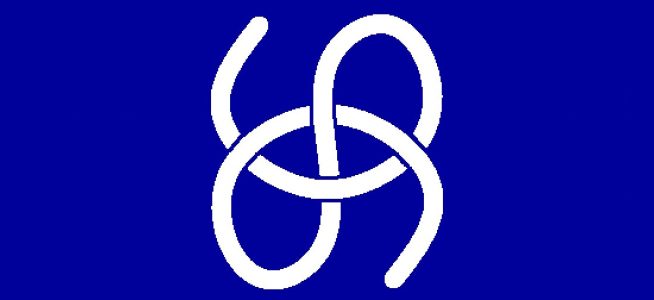
The picture below is of a sculpture piece called Intuition, which stands in front of the Isaac Newton Institute (INI) in Cambridge. It is in the form of the Borromean Rings, a set of three interlocked rings, no two of which encircle each other. Knot Theory Knot theory is an active research area today. In … Continue reading On Knots and Links
The Citizens’ Assembly: Why do 10 Counties have no Members?
Recently, the Irish Government established the Citizens' Assembly, a body of 99 citizens that will consider a number of constitutional issues. The Assembly meets on Saturday to continue its deliberations on the Eighth Amendment to the Constitution, which concerns the ban on abortion. It will report to the Oireachtas (Parliament) on this issue in June … Continue reading The Citizens’ Assembly: Why do 10 Counties have no Members?
Unsolved: the Square Peg Problem
The idiom “square peg in a round hole” expresses a mismatch or misfit, often referring to somebody in the wrong profession. It may also indicate a difficult or impossible task but, of course, it is quite simple to fit a square peg in a round hole, hammering it in until the corners are tight against … Continue reading Unsolved: the Square Peg Problem
Twenty Heads in Succession: How Long will we Wait?
If three flips of a coin produce three heads, there is no surprise. But if 20 successive heads show up, you should be suspicious: the chances of this are less than one in a a million, so it is more likely than not that the coin is unbalanced. Waiting Time for a Single Head On average, … Continue reading Twenty Heads in Succession: How Long will we Wait?
The Edward Worth Library: a Treasure Trove of Maths
Infinite Riches in a Little Room. Christopher Marlowe. The Edward Worth Library may be unknown to many readers. Housed in Dr Steevens' Hospital, Dublin, now an administrative centre for the Health Service Executive, the library was collected by hospital Trustee Edward Worth, and bequeathed to the hospital after his death in 1733. The original book … Continue reading The Edward Worth Library: a Treasure Trove of Maths
Raphael Bombelli’s Psychedelic Leap
The story of how Italian Renaissance mathematicians solved cubic equations has elements of skullduggery and intrigue. The method originally found by Scipione del Ferro and independently by Tartaglia, was published by Girolamo Cardano in 1545 in his book Ars Magna. The method, often called Cardano's method, gives the solution of a depressed cubic equation t3 … Continue reading Raphael Bombelli’s Psychedelic Leap
 ThatsMaths